
CRA seeks stakeholder input to finalise County Recurrent Budget Ceilings for FY 2027-2028
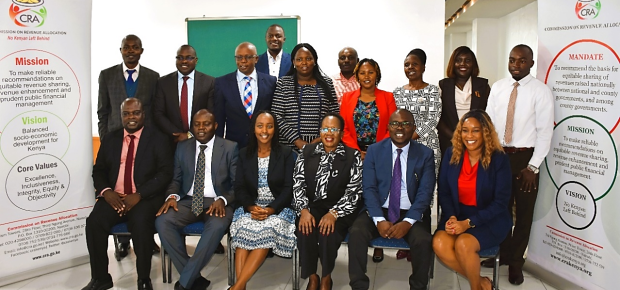
The Commission on Revenue Allocation (CRA) last month concluded consultations with key stakeholders on the proposed County Recurrent Expenditure Budget Ceilings (Ceilings) for the Financial Year 2027-28, bringing together county governments, county assemblies and national institutions to review the proposed expenditure limits and provide input ahead of finalisation.
The consultations, held on 19, 21 and 22 October 2026, brought together representatives from the Council of Governors (CoG), the County Executive Committee Members (CECMs) for Finance Caucus, the County Assemblies Forum (CAF), the Society of Clerks at the Table in Kenya (SOCATT-K), and county executives and assemblies, whose recurrent expenditures are directly affected by the ceilings.
Other key institutions represented included the Salaries and Remuneration Commission (SRC), Office of the Controller of Budget (OCOB), Ethics and Anti-Corruption Commission (EACC), Office of the Auditor General (OAG) and Parliamentary Budget Office (PBO).
The engagements provided a platform for stakeholders to examine the proposed ceilings, seek clarification on the costing framework and raise issues for consideration in the Commission’s final recommendations.
These consultations are coming against the backdrop of eminent leadership transition in the county governments and assemblies after the August 2027 general elections, a more constrained fiscal space and increasing demand for service delivery and accountability by the citizens.
Since the year 2013, the CRA has consistently developed recurrent expenditure budgets ceilings in line with its constitutional mandate of prudent financial management and the Section 107(2A) of the Public Finance Management Act, which require the Commission to make recommendations on matters relating to county financing and financial management for county governments.
How are County Recurrent Expenditure Budget Ceilings developed?
The development of County Recurrent Expenditure Budget Ceilings is a consultative process that brings together key stakeholders to determine appropriate limits for recurrent spending by county executives and assemblies. The ceilings help counties plan and manage their operations, ensuring that public resources are used prudently to support service delivery.
Recurrent expenditure covers the regular costs of running county governments, including salaries, allowances, administrative expenses and other operational costs. Budget ceilings set limits on this spending, helping counties manage costs, promote fiscal discipline and balance operational needs with resources available for development and service delivery.
In developing its recommendations, CRA considers the relevant legal and policy frameworks, prevailing economic conditions, statutory obligations, remuneration guidelines and the operational needs of county governments. The process also considers the need to ensure that county executives and assemblies have adequate resources to discharge their respective mandates.
As part of this process, CRA engages stakeholders to review the proposed ceilings, explain the costing framework and receive feedback on the financial and operational implications for the upcoming budget cycle.

The consultations usually involve county executives and assemblies from all 47 counties, represented through their respective institutions and forums, including the CoG, CECMs for Finance Caucus, CAF, SOCATT, SRC, OCOB, EACC, OAG, PBO and Intergovernmental Relations Technical Committee (IGRTC). These institutions contribute diverse perspectives on remuneration, budget implementation, accountability, oversight and intergovernmental coordination.
The feedback received during the engagement helps the CRA refine its recommendations, considering the operational needs of county governments, fiscal sustainability and the need for responsible use of public resources.
Cross-cutting concerns
During the consultations, a number of issues were raised by the stakeholders for CRA for considerations based on its presentation.
i. Cost of Running the County Governments
Counties argued that the ceilings needed to reflect the actual cost of running the county operations, in the maintenance of existing infrastructure, furnishing of chambers under construction, office equipment, vehicle replacement, utilities, insurance, legal services, and staff and member training.
They also proposed that intergovernmental activities, including the CASA games, the CAF Legislative Summit and the Council of Governors’ Devolution Conference should be accommodated as they are part of recurrent county expenditure. Counties also pray that pending bills and other outstanding obligations should be factored in the recurrent budget expenditures.
ii. SRC Circulars
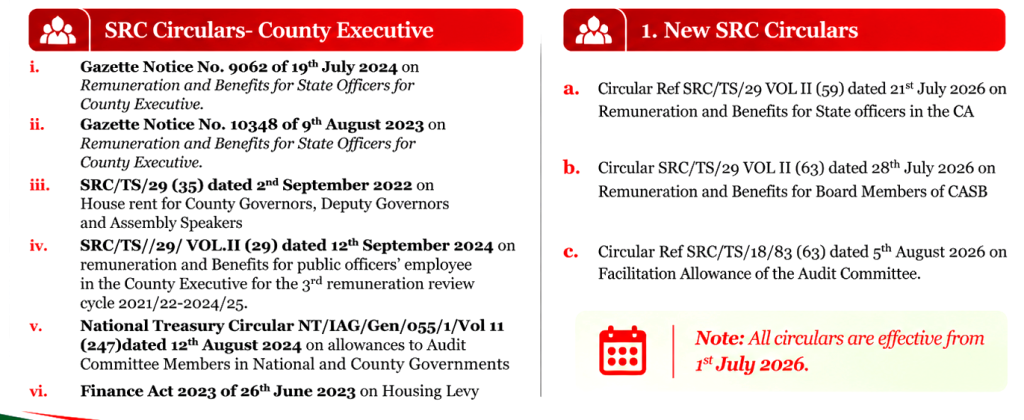
Counties were concerned about cases where SRC circulars have been issued or withdrawn during the budget implementation cycle or circular issues are normally not adequately provided for in proposed ceilings, as it interferes with the running of county budgets and operations. Stakeholders emphasized that remuneration decisions should be communicated in good time and aligned with the budget calendar to avoid unfunded obligations.
iii. Costing of Staff
Stakeholders raised concerns over the proposed staffing parameters, particularly the number of support staff attached to Members of County Assemblies (MCAs). They proposed increasing the number from three, as recommended by CRA, to five, arguing that the proposed limit would not adequately meet the technical and operational support needs of MCAs.
Stakeholders also questioned whether CRA’s proposals on staffing parameters fell within its mandate, noting that County Assembly Service Boards (CASBs) are legally empowered to establish offices necessary for the effective discharge of county assembly functions. They sought clarification on the criteria used to determine the proposed staffing levels and called for further engagement with the relevant stakeholders to address these concerns.
iv. Public Participation expenses
Stakeholders were also concerned that the proposed expenditure ceilings may not adequately cater for the actual costs of public participation. They noted that public participation is a constitutional requirement and an critical part of county decision making processes. Inadequate provision for these activities could undermine meaningful citizen engagement and expose county governments to legal challenges over decisions made without sufficient public involvement. Stakeholders therefore urged CRA to consider realistic expenditure limits that would enable county executives and assemblies to undertake effective public participation while remaining within their recurrent expenditure ceilings.

v. Provision for court-related expenses
Stakeholders urged CRA to consider the growing financial burden of litigation against county governments when determining recurrent expenditure ceilings. They noted that counties are increasingly facing court cases, some resulting in substantial financial obligations that put pressure on their recurrent expenditure limits. Machakos County was cited as an example, having reportedly been ordered to pay KSh 32 million to a litigant. Stakeholders were concerned that such unforeseen legal obligations could strain the ceilings available for other essential county operations and called for these costs to be considered when determining the proposed ceilings.
vi. Other costs
Stakeholders requested CRA to include other expenditure items not captured under O&M e.g. Medical and general insurance, internet, maintenance of aging motor vehicles, and funding for essential annual county conferences and sporting activities. Additionally, CRA was asked to factor transition expenses into the recurrent budget to cover for incoming assemblies’ and executive inductions and other related costs.
